

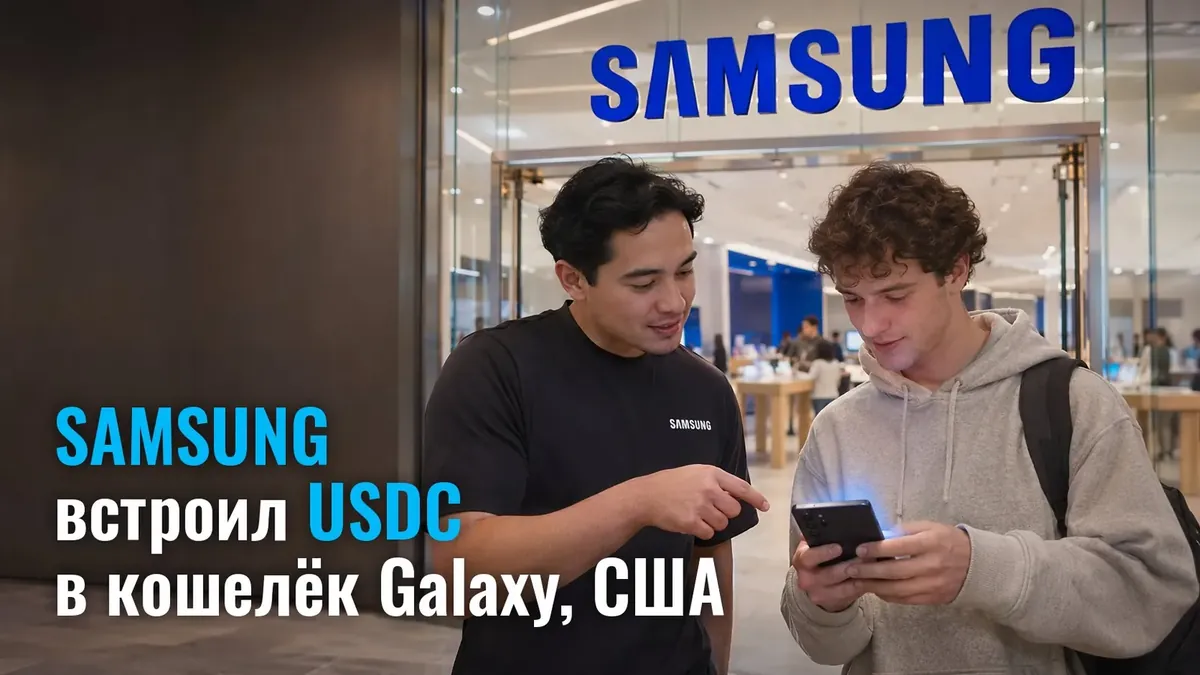
Samsung has built the USDC stablecoin directly into the Galaxy wallet. Starting November 5, smartphone owners in the US can buy, store, send and receive USDC on the Solana network. The feature covers about 82 million compatible devices.
USDC is a stablecoin from the company Circle. Its rate is pegged to the dollar, meaning one token is worth roughly one dollar. Solana is the blockchain on which these tokens move between wallets.
For a trader, this is about Solana. Retail payments from a major smartphone manufacturer now go through this network by default.
How does it work inside?
No separate app is needed. The account is created inside the regular Samsung wallet, and the user does not store the private keys themselves.
A private key is a secret code used to confirm a transfer of funds.
- Access - US residents aged 18 and over, except in the state of New York
- Devices - Android 13 and above
- Developer - Bastion, a licensed stablecoin custodian
- Storage - Coinbase as sub-custodian, the Coinbase Prime Vault service
Samsung separately stipulates that this is a crypto wallet, not a bank account.
How much does it cost?
The fees are announced upfront.
- Transfers with no fee. Sending to other Samsung Wallet users in the US and to compatible external wallets carries no Samsung fee.
- Top-up from a card - 4%. This also includes payment via Samsung Pay.
- Withdrawal in 60+ countries. Funds go to bank accounts in more than 60 countries, and the price varies by country.
- Bonus for new users. On the first top-up of $50 or more, $25 in USDC is credited.
Why Solana specifically?
Samsung chose the network for transfers on October 7. Talk of stablecoin support had been going on since the summer.
Wonchul Chae, head of the digital wallet division in Samsung's mobile business, explains the launch by saying that sending money becomes faster without complex crypto tools. Solana Foundation President Lily Liu: "For ten years, stablecoins have proven that the technology works."
What happens next?
- Paying with stablecoins - Samsung promises payments in stores and online
- New markets - expansion with an eye on local regulation
- Flow into Solana - retail payments are coming to the network by default
SOL can't be traded everywhere. The list of instruments is worth checking in advance and choosing a challenge suited to crypto before buying.
Do you hold SOL in your portfolio?
News like this about the network is usually traded through SOL. And here everything comes down to the program's rules. One prop firm has a couple of dozen crypto instruments on its list, and SOL is among them. Another offers only BTC and ETH, while a third closes positions before the weekend and doesn't let you hold an idea for longer than a day. Leverage on altcoins also differs from firm to firm, and it is calculated separately from the main drawdown. It's easier to filter out unsuitable conditions in advance than to learn about them on your second trade.