

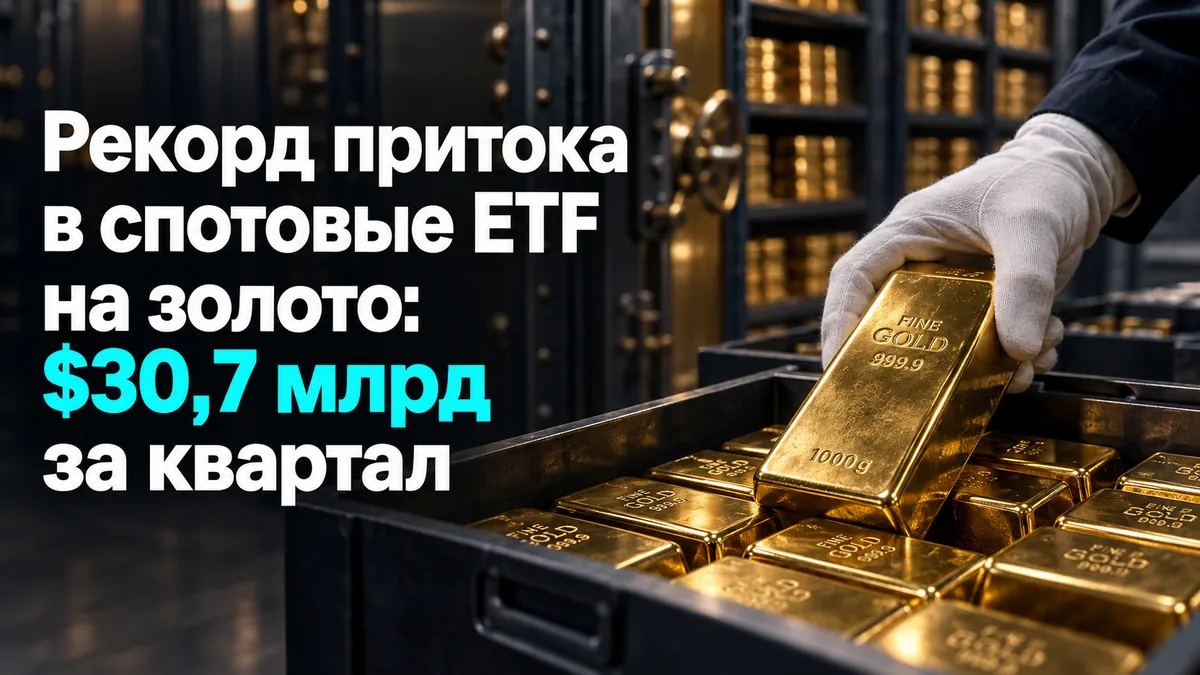
Global ETFs backed by physical gold ended the third quarter with record capital inflows. Over three months, investors directed about $30.7 billion into such funds. This is the highest quarterly result in the entire history of observations.
How flows changed
In August, gold ETFs received about $17.9 billion. This became the second-best monthly result in history. In September, inflows amounted to another $10 billion. Thus, the bulk of the record quarterly result came in the last two months of the period.
Gold reserves hit a new high
During September, the total volume of physical gold in ETFs increased by approximately 67 tonnes. Total reserves reached 4,256 tonnes. The previous high was about 4,176 tonnes. Since the beginning of the year, fund reserves have grown by approximately 226 tonnes.
How much money has come in since the start of the year
Cumulative inflows into gold ETFs since the start of 2026 have reached approximately $38.5 billion. Positive flows were observed in all major regions. This is especially notable against the backdrop of large outflows that the market saw earlier. In March, about $11.7 billion exited funds, and in June, another $9.2 billion.
Funds buy gold on the dip
Despite the fact that gold has remained below previous levels since the start of the year, ETF reserves continue to grow. By one estimate, total reserves reached about 100.9 million ounces, the highest since August 2022. This shows that institutional investors are not only not exiting the metal, but are also using the price decline to increase positions.
The UK has taken the lead
The geography of demand has also changed. Funds traded in the UK have attracted about $9.5 billion since the start of the year. By this measure, the country has overtaken China and become the largest single source of demand in 2026.
Central banks continue buying
Demand is not formed only by ETFs. Central banks also continue to increase gold reserves. In August, they bought about 39 tonnes of gold. Uzbekistan increased reserves by approximately 8 tonnes, while Russia reduced them by 6 tonnes.
What is happening on the Moscow Exchange
Activity has also increased in the Russian market. Gold turnover on the Moscow Exchange in September nearly doubled and reached 542.2 billion rubles. At the same time, private investors accounted for only about 5.6% of transactions. This shows that the main volume is still formed by large participants.
Why this matters for XAU/USD
When funds and central banks actively increase positions, flow reports become an important benchmark for the gold market. Changes in demand from major players can amplify XAU/USD movement both upward and downward. Therefore, it is important for traders to monitor not only the dollar and the Fed rate, but also institutional flows into the metal itself.
What's next
The main question is whether the record pace of inflows will persist in the fourth quarter. If funds continue to increase reserves even against the backdrop of a weak price, this will be a signal of sustained institutional demand. If flows begin to reverse, pressure on gold may intensify.
Trading gold with a minimum lot?
In the gold market, tens of billions of dollars move through ETFs and central bank reserves, while a private trader's result is often limited by the size of their own deposit. In prop trading, the trading nominal is provided by the company after passing an evaluation, and profit is distributed according to pre-established conditions. It is worth understanding the mechanics in advance, while institutional flows into gold remain at record levels.