

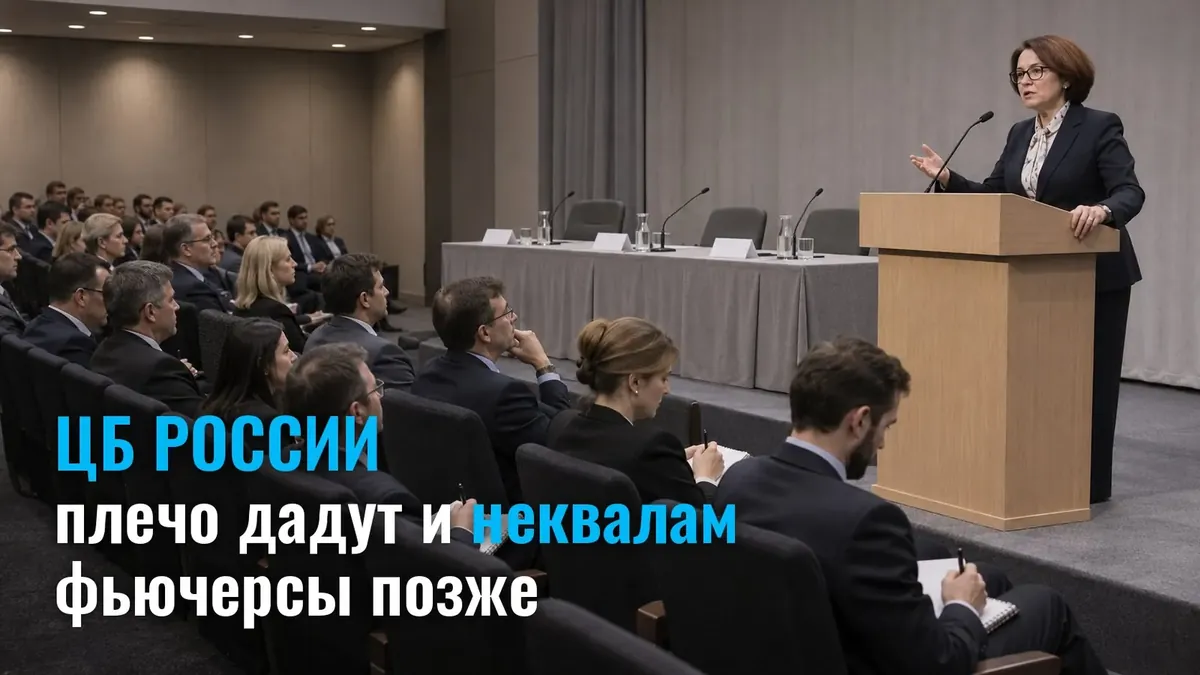
The Bank of Russia promises to open leveraged cryptocurrency trading to unqualified investors. The statement was made by Olga Shishlyannikova of the Central Bank.
Leverage, or margin trading, means transactions using the broker's borrowed funds. An unqualified investor is an ordinary private investor without qualified status.
Spot trading, that is, transactions with the coins themselves, will be opened by exchanges on November 22. The Central Bank will allow crypto futures for ordinary investors separately and later. This determines which crypto instruments are available to a private trader.
Leverage will be opened to unqualified investors
Olga Shishlyannikova of the Bank of Russia announced the leverage: margin trading (transactions using the broker's borrowed funds) will also be permitted for unqualified investors.
Qualified status is granted based on capital, experience or specialized education; most private traders do not have it.
- For unqualified investors - spot trading of coins from November 22 and the leverage promised by the Central Bank.
- For qualified investors - futures on Bitcoin, Ethereum, Solana, Ripple (XRP) and Tron on Russian exchanges; the Central Bank authorized them in 2025.
Futures await risk review
Deputy Chairman of the Central Bank Filipp Gabunia on November 19 at the NAUFOR Ural Conference called allowing unqualified investors into such transactions a very sensitive topic. He did not give a timeline.
Filipp Gabunia, Deputy Chairman of the Bank of Russia: "If we don't see the risks, we will allow it."
A futures contract is a contract whose price is tied to the coin's exchange rate; there is no need to buy the coin itself.
What is already working
Gabunia gave the market figures.
- The law "On Digital Currencies and Digital Rights" has been in force since September 1.
- 10 digital depositories are already operating in the country; they keep records of rights to such assets.
- 29 crypto exchangers - slightly more than there were when the market was in the grey zone.
- Exchange trading can open from November 22, after preliminary agreement of the rules with the Central Bank. The Moscow Exchange announced a start on December 1.
What this means for the trader
The regulator does not expect large turnover. Gabunia named three of his priorities.
- Product selection - investors should not be sold unsuitable products.
- Honesty - investors should not be deceived.
- Commissions - they should not be inflated.
For the trader, this means that the set of permitted coins and derivatives on them will change as the launch proceeds.
Without one's own capital, one trades on a prop company's account: how this works is explained in the academy, and the companies themselves are collected in the catalog.
Leverage will be given, but the account stays yours
Leverage stretches the position, the risk remains on your money, and the ceiling is set by the balance in the account. With prop companies, the nominal goes the other way. You pay for the selection, trade within the company's drawdown limits and take a share of what you earn from its account. Comparable own capital is not needed for this. It is more convenient to understand the scheme now, while the Russian market is just opening.
Will you take leverage on crypto when it is opened to unqualified investors, or will you wait for futures?