

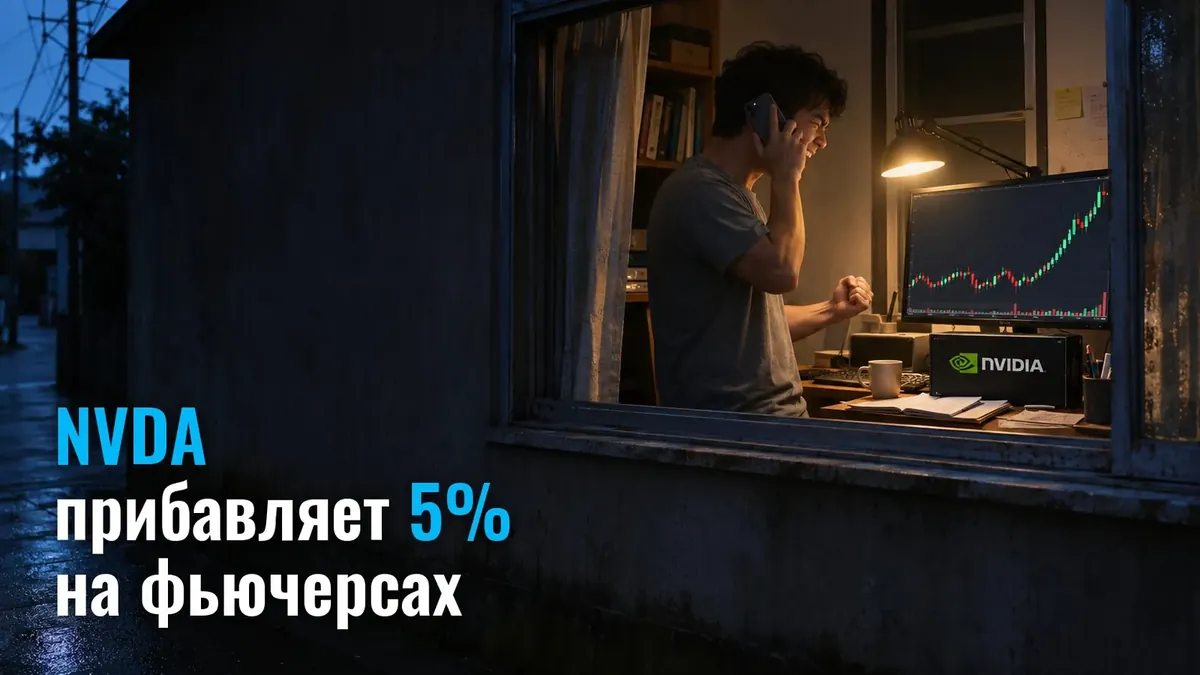
Nvidia shares are up 5% in futures trading on the morning of November 23. The main session in the US has not yet begun at this time; the exchange is closed.
A futures contract is a contract for the future price of a security; it is traded during hours when the venue is not operating. Therefore, before the open, the share price can only be seen there.
Nvidia makes accelerators for artificial intelligence computing. This concerns traders more broadly than a single security: alongside NVDA, futures on the S&P 500 and Nasdaq 100 are being repriced.
What does the measurement show?
- 10:12 MSK - the time of the NVDA measurement, plus 5% on the futures contract.
- No catalyst - the report contains only the price reaction on the derivatives market.
- Lower volume - there are fewer participants on the futures than in the daily session.
US exchanges are closed, so all repricing right now is being done by the futures.
Why do the indices follow?
- Market cap - Nvidia is among the most valuable companies in the S&P 500 and Nasdaq 100.
- Index futures - its 5% drags the contracts on both indices along with it.
- Chip sector - alongside NVDA, shares of other chipmakers are moving.
For the indices, such a move weighs more than the movement of almost any other security.
What does this mean for a trader?
Key point: while New York is closed, NVDA's price is set by a low-volume futures contract, and both indices are repriced off it as well.
Trading indices - check your program's conditions in advance. On the website you can pick a challenge for indices by trading style and market.
How the challenge works and what the payouts consist of is covered in the academy.
What's next?
The next reference point - the market open in New York.
- Gap vs. the close - before the open it can both narrow and widen.
- Price jumps - during such hours the quote moves in leaps.
- Spreads - they are wider than usual.
Did you look at this futures contract this morning?
In the morning, the futures contract in the terminal shows plus five percent. What matters next is whether your account rules will let you into such a gap. On indices, prop firms' limits vary: some prohibit holding a position overnight and over the weekend, others block entry before the session open. All of this is written in the conditions before you pay for the challenge. A filter by market and risk size will weed out programs where indices are restricted.