

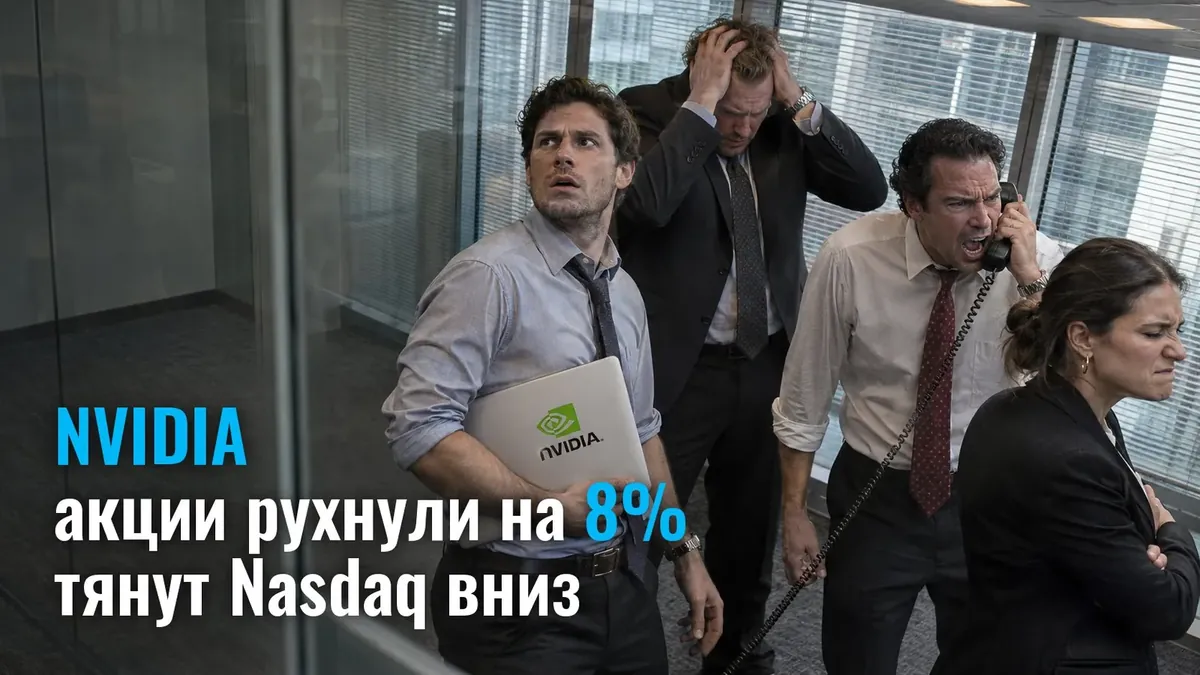
Nvidia shares fell 8% on November 25. By 17:54 Moscow time, the stock had dropped twice as deep as the day before: then the decline was 4%. The growth streak was broken that same day.
Nvidia makes chips for artificial intelligence systems, and its shares trade on the exchange under the ticker NVDA. The stock is included in the calculation of the S&P 500 and Nasdaq 100 indices. The index is calculated from a basket of stocks, so the weight of a large stock drags it along.
The drop pulled Nasdaq 100 futures down. A futures contract is an agreement on the future price of an asset, in this case the index price. Moves in NVDA also show up on the chart of those who trade the indices.
How did the decline unfold?
Over two trading days, the decline has been accelerating.
- minus 4% - the first day of the decline, the end of the growth streak
- minus 8% - the second day, during the US session
- 17:30 Moscow time - session open; the main volume in the stock passes closer to the evening Moscow time
Why does this affect the indices?
The reason for the sell-off is not given in the report on the move. Only the dynamics are visible: the day before, the stock had already lost part of its price, and sellers kept pressing.
- S&P 500 and Nasdaq 100 - indices whose calculation includes NVDA
- index futures - follow such candles in the stock
- US technology sector - moves in the same direction
What does this mean for a trader?
Key point: if you trade indices rather than individual stocks, moves in this stock still show up on your chart.
How the challenge and payouts work is explained in the academy. There it is also clearer why you should choose a challenge to match the indices.
What to watch before the close?
The outcome of the day will be decided by the close of the US session.
- The close: whether the decline holds near 8% or part of the drop is bought back by the evening.
- The index open: the level from which they start the next day depends on the session's result.
Did you watch this NVDA candle?
Eight percent in a single stock plays out both on the short side and on the bounce. The only question is position size. In an account of a couple thousand, such a move is closed out by an amount you don't even count. In prop trading, the trading notional is provided by the company: first a paid evaluation, then its account and a pre-defined share of profit for the trader. It is calmer to understand this mechanic now than on the next evening like this in Nasdaq.