

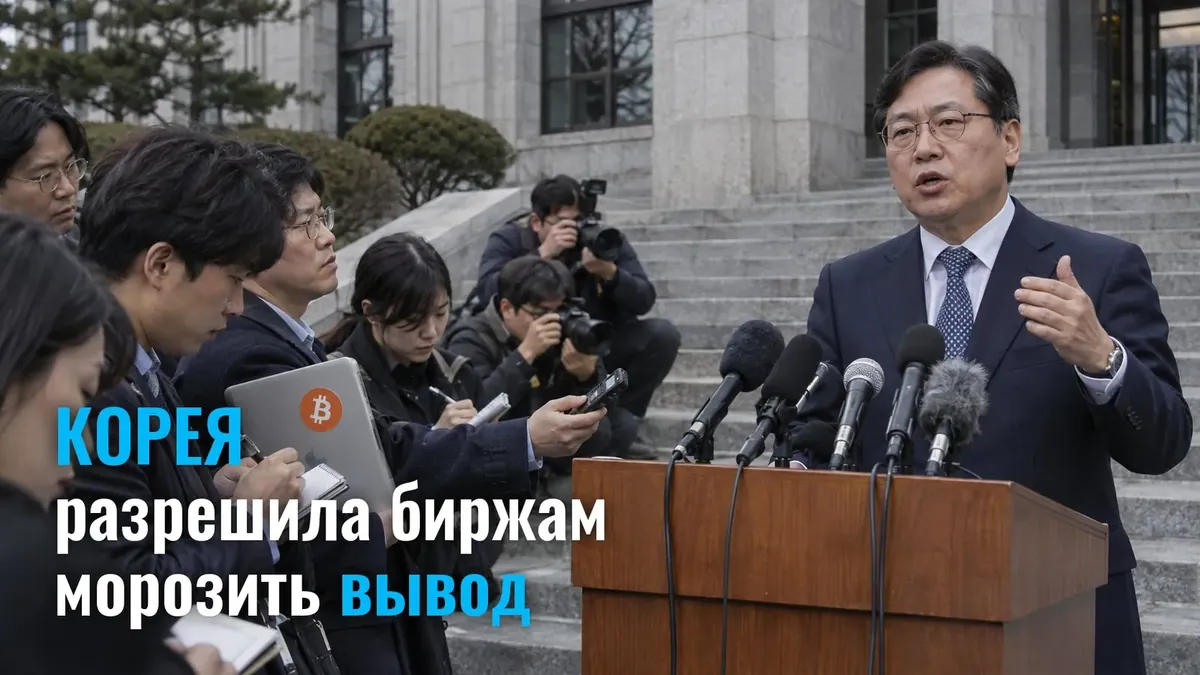
South Korea's financial regulator will allow exchanges to halt deposits and withdrawals on suspicion of a hack. The FSC announced the decision on Thursday, November 12.
The instrument is called a no-action letter. It is the regulator's promise not to punish an exchange for an action that formally goes beyond the rules. Previously, blocking withdrawals without clear evidence of an incident was not allowed.
For the exchange's client, this means one thing: access to money can now be closed even before a leak is confirmed.
What will the regulator allow?
- Freeze on suspicion - the exchange halts deposits and withdrawals without waiting for confirmation of an attack.
- Protection from a fine - the regulator will not raise claims over such a halt.
- Details - the specific conditions and effective date have not yet been disclosed.
Why now?
The trigger was two incidents at Korean platforms.
- GOPAX. The exchange of operator Streami halted trading, deposits and regular withdrawals on Friday after a hack threat. A representative stated that there was no hack.
- Prabang. The platform suspended operations on October 24 due to anomalous debits from a hot wallet, losses - about $70,000. A hot wallet is a storage connected to the network from which fast payouts are made.
October audit. The FSC examined 555 financial companies in the country and found cybersecurity deficiencies in 130 of them. Streami and Prabang were among the 16 companies that had already had security incidents.
What will be required of exchanges?
- Round-the-clock monitoring - observation and response without breaks.
- Cold wallets - hold a large share of funds in them. A cold wallet is a storage without a connection to the network.
- Insurance and reserves - more serious than now.
- Operating hours - platforms without continuous monitoring process deposits and withdrawals only during duty shift hours and warn clients in advance.
What does this mean for a trader?
Money on a Korean exchange may become inaccessible on a single alarm signal, and formally there will be no claims against the platform.
Key point: plan your deposit before a trade and your profit withdrawal with a time buffer.
The scheme for trading on a company's capital is covered in the academy, and the platforms themselves - in the prop firm catalog.
Money is on the exchange, and it has closed withdrawals
A position is open, and access to the account depends on how the exchange's night went. Growing a deposit in such a scheme is scary. The larger the sum sitting on the platform, the more costly every piece of news about anomalous debits. In prop trading, the trading notional is held by the company: you pay for selection according to its rules and receive a share of what you earn. It is calmer to understand the mechanism before the next withdrawal freeze.