

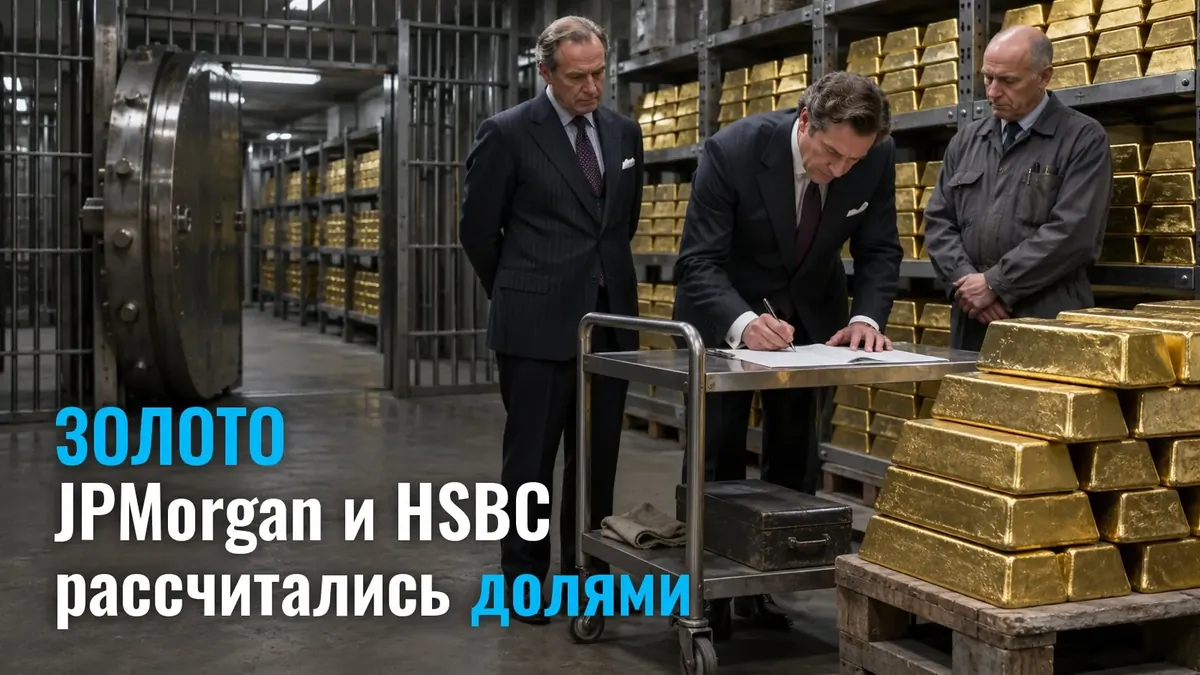
JPMorgan, HSBC and StoneX conducted the first fractional gold settlement in London. It happened on November 24: participants transferred rights to parts of bars from the vault to each other, settled on them and accepted the shares as collateral. The gold itself was not moved anywhere.
A fractional share is a right to a part of a bar that sits in a vault. Owners hold the metal jointly, and trades are made in shares. Collateral here means security for a transaction.
This directly affects traders. Gold settlements are being moved into digital form, while the ounce has fallen 9.3% over the month.
How PGI shares work
The instrument is called PGI - shares in a common gold pool. Participants own the stored metal jointly and issue digital shares against it.
- 0.001 troy ounce - the minimum size of such a share.
- 400 ounces - the weight of a standard allocated bar in London, about 12.4 kg.
- September 2025 - the World Gold Council announced a pilot; the regime is still a test one.
Why banks need this
Mark Amlin, head of physical commodities at JPMorgan, expects the metal to be used more widely in financial markets as collateral for transactions.
- Holder protection: rights to a share are protected in the event of an intermediary's bankruptcy.
- Collateral: shares were accepted as security right in the first transaction on November 24.
- No transport: the metal did not leave the vault.
London remains the main warehouse: its vaults hold more than $1 trillion of gold along with the Bank of England's reserves.
- Five banks handle settlements: Citigroup, ICBC Standard Bank, UBS, HSBC and JPMorgan.
- $180 billion of $361 billion - that is how much fell to the London over-the-counter market in 2025 at that average daily global turnover.
Asia and regulators are not waiting
Asia is rushing ahead with its own precious metals infrastructure, while British regulators are working through the rules.
- Hong Kong has been testing unified precious metals clearing since July 7, with launch in Q1 2027.
- Singapore opened a 500-tonne vault for foreign central banks on November 10.
- The FCA closed its consultation on tokenisation on October 23 and, together with the Treasury and the Bank of England, is discussing exemptions for gold.
Tokenisation is the conversion of rights to an asset into digital form.
What this means for the trader
The ounce is now around $3625. Over the month that is -9.3%, and from the January high near $5600 the metal has lost more than 35%.
- $90 billion - spot turnover of tokenised gold (XAUT, PAXG) in Q1 2026, more than for all of 2025.
- Terms of prop offers on metals are collected in the catalogue of prop firms; a programme for trading gold is selected by the challenge calculator.
Key point: the ounce gave up 9.3% over the month, while gold settlements are at the same time moving into digital shares.
Were you long gold during this dump?
You have already traded through the ounce's 9.3% monthly drop live: overnight gaps, widened spread. In prop programmes gold is specified separately: in some places the volume limit on XAU/USD is lower than on currency pairs, in others the metal cannot be held over the weekend. These lines decide whether the account survives to your winning idea. Checking them against the terms is faster than arguing about a block later.