

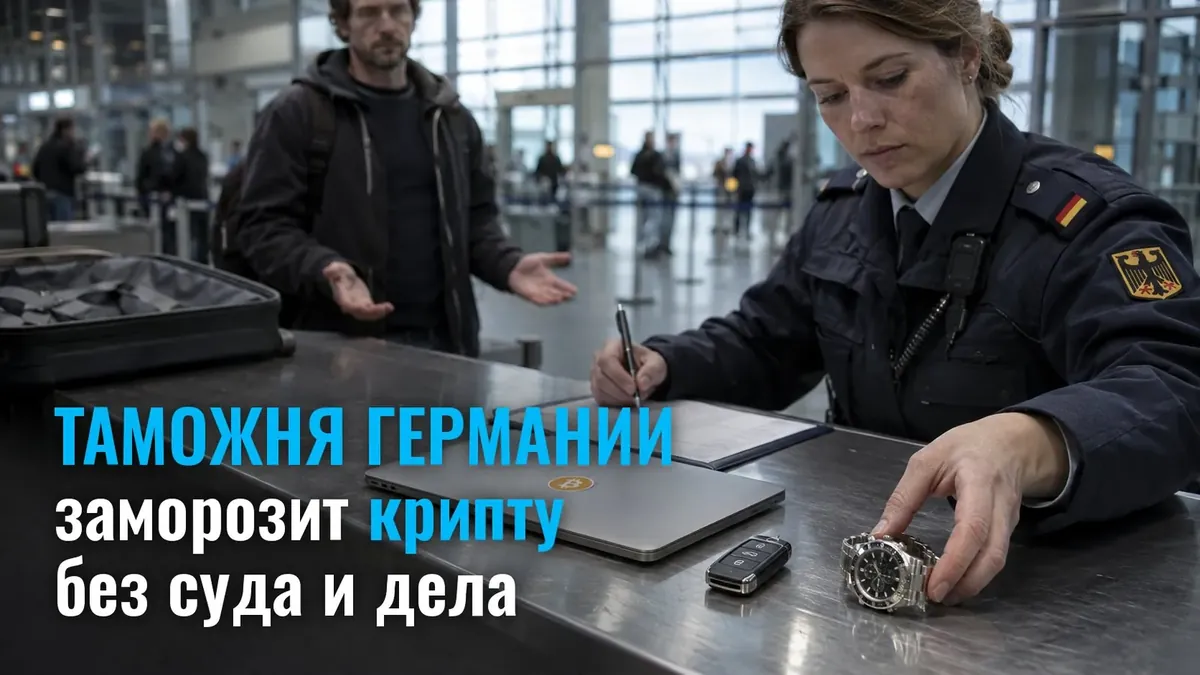
The Bundestag passed the customs financial fairness law. The vote took place on November 12. Customs will get the right to freeze assets worth more than €100,000 for up to 180 days, even without a criminal case.
The Bundestag is the lower house of the German parliament. A freeze means that money or coins cannot be used while a check is underway. Here, an asset is considered to include both cash and cryptocurrency.
The owner must prove where the money came from. For a trader, this means that German customs will stop a large sum without a criminal case or a court verdict.
What falls under the freeze
The mechanism is called by the government a "suspicious state order." It covers "significant" assets, usually from €100,000 (about $111,000).
- Cash, cars, watches, cryptocurrency - customs has the right to freeze all of this.
- No court verdict is needed - the order alone is enough for the freeze itself.
- Permanent confiscation goes through court - after an amendment by the ruling coalition, such a decision is made by a panel of judges at the financial court.
Who pushed the law
The author of the idea is Finance Minister Lars Klingbeil.
Lars Klingbeil: "We are sending criminals a clear signal: we are getting tougher." He spoke more directly about confiscated luxury goods: "Porsches and Rolexes are still disappearing."
- Part of a big plan - the law is part of the plan to fight organized crime adopted on February 25, 2026.
- Payment control - customs will monitor cross-border digital payments more broadly.
- Money for the budget - the law is expected to bring €308 million (~$342 million) in additional revenue.
Who voted against
In the finance committee, the CDU/CSU, SPD and AfD voted in favor. The Left were against, the Greens abstained.
- €100 billion - this is the estimated volume of money laundering in Germany, and against this backdrop €308 million looks modest, the Greens noted.
- Courier versus banker - The Left believe that the confiscation procedure is "built for the cash courier, not the banker."
What happens to the law next
The next step is approval by the Bundesrat. This is the chamber of the states.
Separately, the Finance Ministry is preparing a 25% tax on income from cryptocurrency starting in 2027. German authorities already have experience with confiscations.
- almost 50,000 BTC - since 2024, Saxony has been selling off coins seized from the operators of the pirate site Movie2K.
- 45,000 BTC - this is how much the analytics company Arkham counted on top of that; they were unable to get to them.
Prop firms and their terms are collected in the catalog, and breakdowns of challenges are in the academy.
Thought about where your trading capital is held?
You read something like this and the first thing you do is count where your money is held and what portion of it you trade with. Growing volume with a single personal deposit takes a long time. Every new thousand in the account is yours, and the risk on it is yours too. In prop trading, the trading nominal is provided by the company: a paid selection according to its rules, then its account and an agreed share of the profit. It is worth sorting out such access before you go to top up your own account again.