

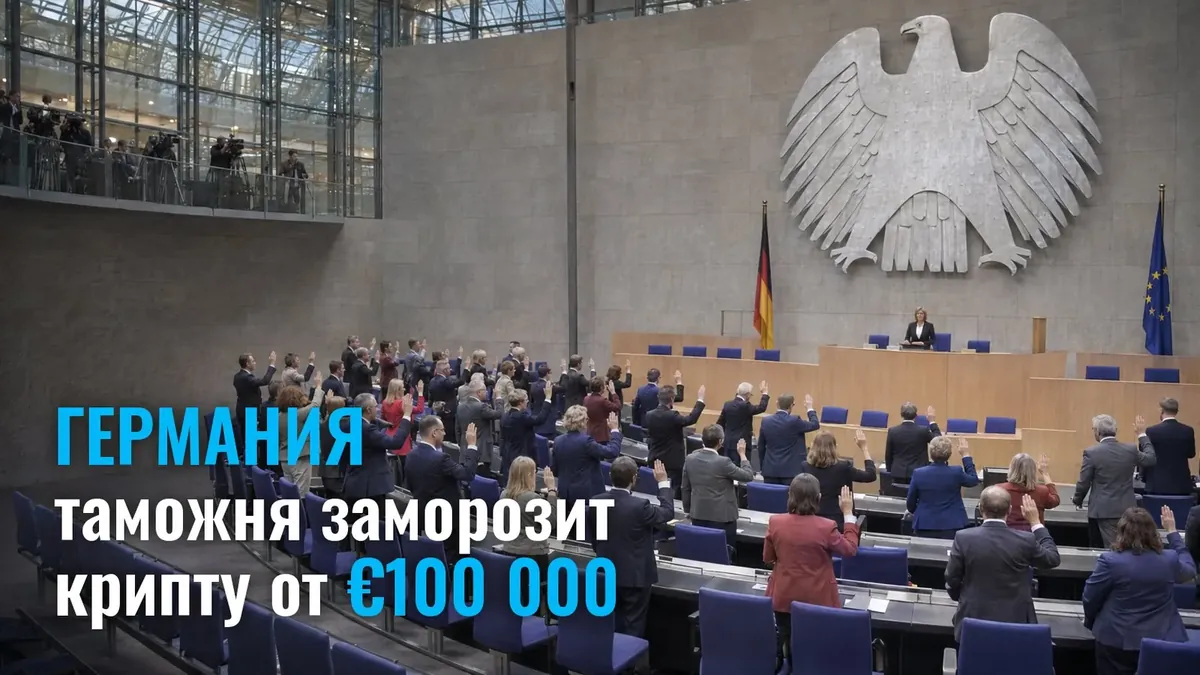
The Bundestag passed the Customs Financial Fairness Act on November 12. German customs will be able to block crypto assets for 30 days without opening a criminal case. The threshold for blocking is €100,000.
The Bundestag is the lower house of the German parliament. Blocking means that the owner cannot dispose of the coins while customs checks their origin. Entry into force is scheduled for January 1, 2027.
This directly affects the owner of a large account. The basis is "factual indications" of illegal origin, that is, the bar is lower than what is needed for a criminal case.
What was customs allowed to do?
The first period is 30 days and without a criminal case. After that, the periods and thresholds are as follows:
- 150 days - that is how long a financial court can extend the blocking, and only once.
- 180 days - the maximum together with the first period.
- €100,000 - the value of assets at which the law starts to apply.
- €50,000 - the threshold for assets subject to registration in a public register.
- Stopping the clock - this is triggered by a confiscation application filed with a court.
Cryptocurrency is included according to the definition from MiCA. MiCA is the EU's general crypto law.
Assets can be taken permanently only through a court. If the court does not recognize the origin as illegal, the application is rejected and the assets are returned.
Why are lawyers against it?
The German Federal Bar Association (BRAK), in a statement dated October 28, called the wording "illegal origin" vague. The objections to the law come down to four points:
- Vague wording. It also covers violations of civil law.
- Inheritance. The owner will not be able to show documents for transactions that are several generations old, and the absence of papers cannot serve as evidence.
- Wallets. The industry association Bundesblock added in March that blockchain analytics does not confirm ownership of a wallet.
- One yardstick. The law measures custodial and self-custodial storage the same way, although the former is held by the platform, while the keys to the latter are held by the owner.
What does this mean for a trader?
The main point: a large crypto account in Germany can be frozen for up to 180 days without a criminal case, and the return of assets goes through a court.
The second path to volume is a prop company account. How the selection and payouts work is collected in the academy, and it is convenient to compare conditions for your market in the challenge selection.
What's next?
- Bundesrat. The law awaits the upper house of the German parliament.
- EU treaty. In October, the EU and eight countries signed a treaty on the freezing and confiscation of criminal crypto; it is also awaiting ratification.
- The eXch platform. In April 2025, €34 million in crypto was seized from it.
- The Movie2k case. In that case, 49,858 BTC were sold in 2024 for approximately €2.6 billion.
Do you trade crypto from your own deposit?
People read a law like this with their own coins and trading volume in mind. Increasing volume usually means depositing more of your own money into the exchange, and that quickly hits a limit. Prop trading works differently: the company admits you to its account after a paid selection, keeps you within its risk limits, and pays the contractual share of what you earn. It makes sense to understand this path in advance.