

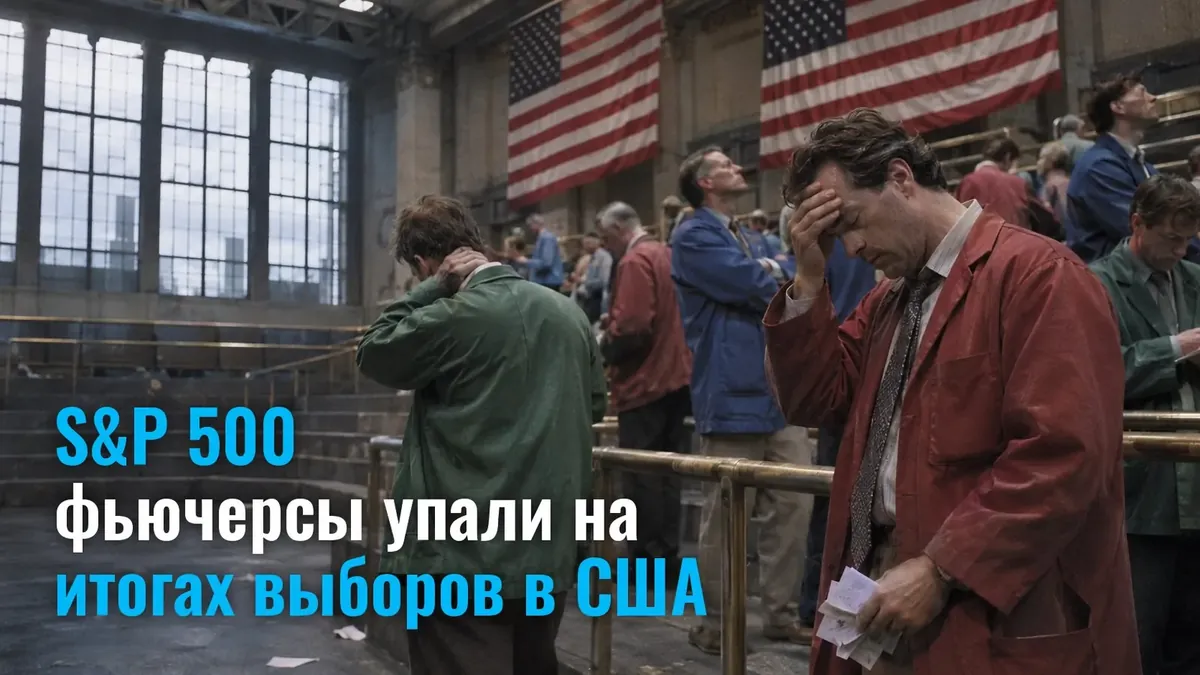
S&P 500 futures turned negative on the morning of November 4. The market is pricing in the outcome of the US vote. The decline began even before the main session opened on the exchange.
The S&P 500 is an index of the 500 largest public companies in the US. A futures contract on it is a contract on the value of this index. It trades almost around the clock, so it reacts to political news at night, while the index itself is closed.
For a trader this means one thing: the price at the open may end up far from yesterday's close.
What is already visible in the price?
Time and instrument. As of 07:23 Moscow time, the decline was in S&P 500 futures specifically, not in the index itself.
- 07:23 Moscow time - the moment the futures decline was recorded
- 17:30 Moscow time - the open of the US session, when the main volume in stocks kicks in
- 500 companies - that is how many of the largest US public companies are in the index
Why did the market go down?
The reason is the election results. The votes are adding up in favor of the Democrats.
Among equity market participants, this interpretation has long held:
- A Republican win. Perceived as positive for the indices.
- A Democratic advantage. Considered a negative factor for the indices.
- The morning reaction. It was this logic that drove the futures move overnight.
What does this mean for a trader?
The mechanics matter, not the politics. When futures move down during the night, a gap appears between the previous session's closing price and the new open.
Such a gap is called a gap: the price starts somewhere other than where it stopped yesterday. Positions left open overnight open straight into a different result.
Key point: the political backdrop for the indices arrives at night, but it is counted against your account in the morning. You can check which events are still coming up today in the economic calendar.
What next?
The next point is 17:30 Moscow time. The main volume in stocks will join the futures at the open of the US session.
- The vote count continues - the backdrop for the indices may still change during the day
- The terms for indices are worth checking in advance in the prop firm catalog
Did you hold indices through that night?
Overnight gaps in futures are a separate story in risk rules. Some prop programs freely allow holding indices overnight. Some require closing everything before the end of the session. With some, drawdown is calculated from the worst point within the day, and the morning gap burns through the limit before you even enter. For indices, such clauses vary more than for any other market. It is worth getting to grips with them on a calm chart, not on the night of a vote count.