

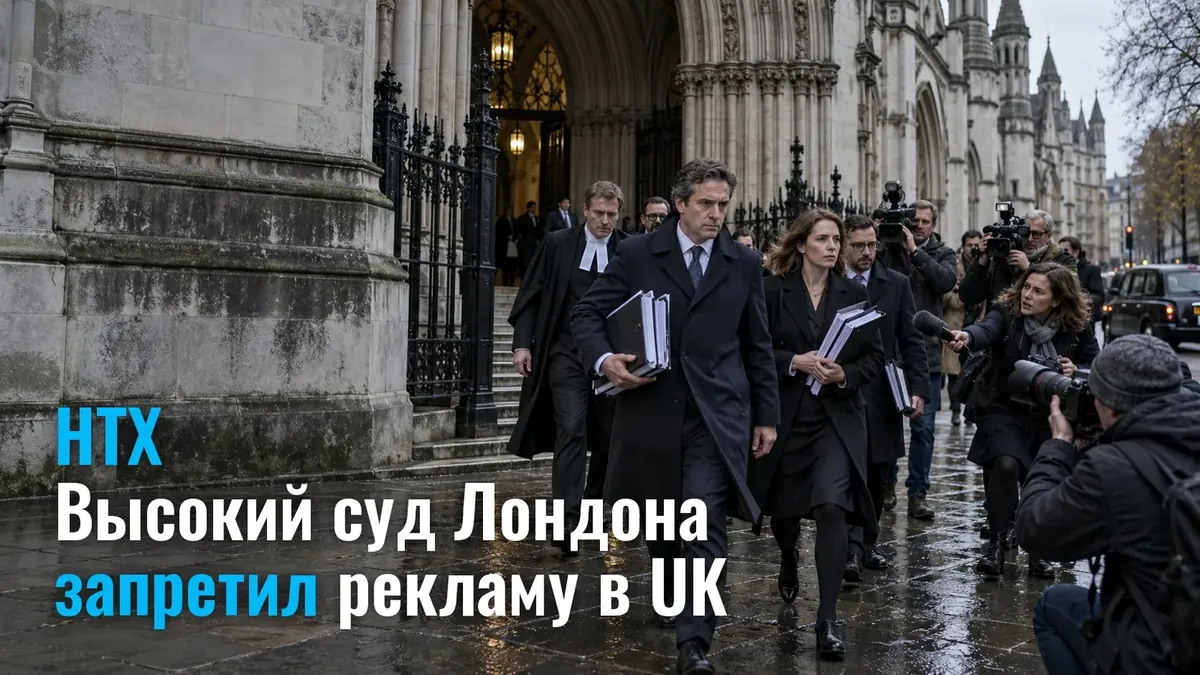
HTX exchange promised the High Court of London not to advertise its services to Britons. The promise was formalized by the FCA, the British financial regulator. For clients from the UK, the platform is already effectively closed.
HTX is a major crypto exchange, formerly known as Huobi. Under British law, advertising financial services to local residents is only permitted with the regulator's authorization. Foreign registration does not exempt one from this rule.
Why this matters to a trader. You can choose a platform based on fees, and then be left without access to it because of a regulator's decision.
What exactly happened?
The FCA formalized the commitments through the High Court of London. In British law, these are so-called undertakings - legally binding promises by the defendant. The party to the agreement is Huobi Global S.A., the legal entity of the HTX exchange.
- Breaching an undertaking is more dangerous than an ordinary regulator's order
- This is already non-compliance with a court decision, not a dispute with a supervisory authority
- The essence of the promise - not to advertise crypto services to Britons in circumvention of the law
How did it all begin?
The FCA filed the lawsuit in October 2025. The reason - violation of British rules on advertising financial products.
- The regulator wrote to the exchange. According to the FCA, HTX repeatedly ignored requests and did not make contact.
- Court proceedings began. After they started, the exchange began to exit the British market.
- The case was closed with a settlement. Instead of a verdict, the parties recorded HTX's commitments.
What has already changed for clients?
HTX no longer operates in the UK. Access was closed in two areas.
- Deposits - users from the country cannot deposit money
- Registration - new British clients cannot open an account
- Advertising - a separate prohibition was recorded on targeting it at Britons and actively attracting them
Steve Smart, the FCA's executive director of enforcement and market oversight, addressed the entire industry.
Steve Smart: crypto companies should not delude themselves - registering abroad does not put them outside British law. The same message applies to the rest: either comply with the rules or face the consequences.
What does this mean for a trader?
Britain is repeating the European Union's logic. In the EU, it was set by MiCA. MiCA is the European Union's general crypto law. The principle is the same: access to local clients only through the regulator's authorization.
- Check the platform's status. For Britain, there is the public FCA Firm Checker register.
- Watch the order of shutdown. When leaving a jurisdiction, the first things blocked are not trading, but deposits and registration.
- Don't wait for a notification. You are not always warned about this.
If you don't want to keep your capital on someone else's exchange, you can compare an alternative in the prop firm catalog or go through the scheme in the academy.
The exchange left - and the account with it?
A familiar story: a platform is chosen for its fees and liquidity. And then the regulator decides it no longer exists in your country. In prop trading, this risk is structured differently: the company provides the trading notional and infrastructure - you pay for the selection, pass it according to its limits, and work with its funds for a share of the profit. Your own capital does not sit on someone else's exchange. It's worth understanding how this scheme works in advance.