

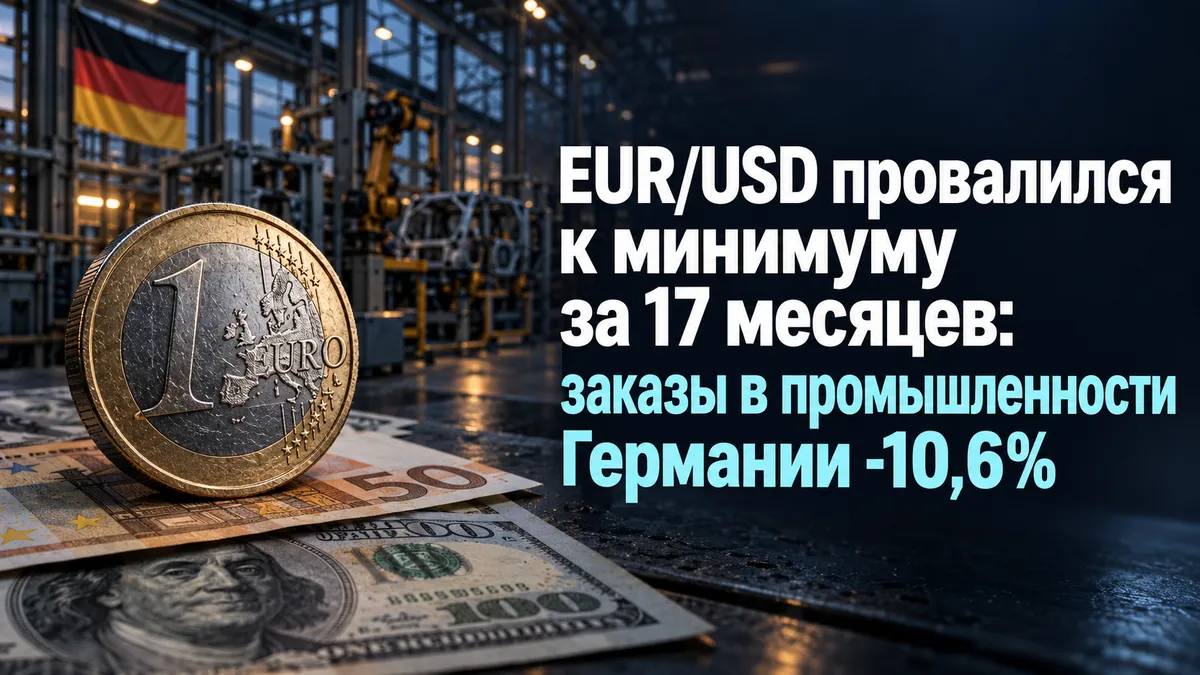
EUR/USD fell to 1.1160, the lowest level in the last 17 months. The main reason was weak data on industrial orders in Germany, which turned out to be significantly worse than expectations.
What happened with EUR/USD
In the Asian session, the pair broke through support around 1.1180 and fell to 1.1160. Later, the euro partially recovered and rose to 1.1221. The final decline for the day was about 0.28%. On Tuesday morning, pressure persists, and the pair has not yet managed to rise sustainably above 1.1230.
What came out for Germany
Industrial orders in Germany for August fell by 10.6% compared with July. The market expected a decline of only 1%. A month earlier, the indicator rose by 2.5%. In annual terms, order growth slowed to 2.7% versus 13.1% previously.
Where such a drop came from
The main collapse came in transport equipment. Orders in this segment declined by about 61% adjusted for seasonal factors. At the same time, excluding large one-off contracts, the overall picture looked much calmer. On that basis, orders declined by only about 0.1%. This means that a significant part of the weak report is related to individual large orders, but the headline figure still increased pressure on the euro.
Additional pressure from Europe
The weak German statistics coincided with persistent debt and political risks in the eurozone. The spread between French and German government bond yields remains at levels the market has not seen since the debt crisis. In France, uncertainty around budget policy persists. The political situation in other large eurozone economies also raises additional questions. Against this backdrop, investors demand a higher premium for European assets, which also weighs on the euro.
What is happening with the dollar
On the other side of the pair, the dollar remains strong. US government bond yields are holding near multi-year highs. Even the weaker ISM Services index could not noticeably change this picture. High yields continue to support demand for dollar assets.
What else is important for the euro
Inflation in the eurozone remains noticeably above the ECB target of 2%. At the same time, Brent fell below $100 per barrel, but is still significantly above the August lows. For the ECB, this is a difficult combination: growth is slowing, but inflationary pressure has not completely disappeared.
What next
The nearest technical support for EUR/USD is around 1.1145. Resistance runs around 1.1285. If pressure on European assets persists, the market may again test the lower boundary of the range.
Did you trade this breakout of 1.1180?
The breakout occurred in the Asian session and produced a noticeable move even before the European market opened. But the result of a trade depends not only on direction, but also on the available trading capital. Prop trading allows you to pass an evaluation stage and gain access to the company's account, working for a share of the profit without needing to use comparable personal capital. It is better to understand the mechanics in advance, rather than after the next strong move.