

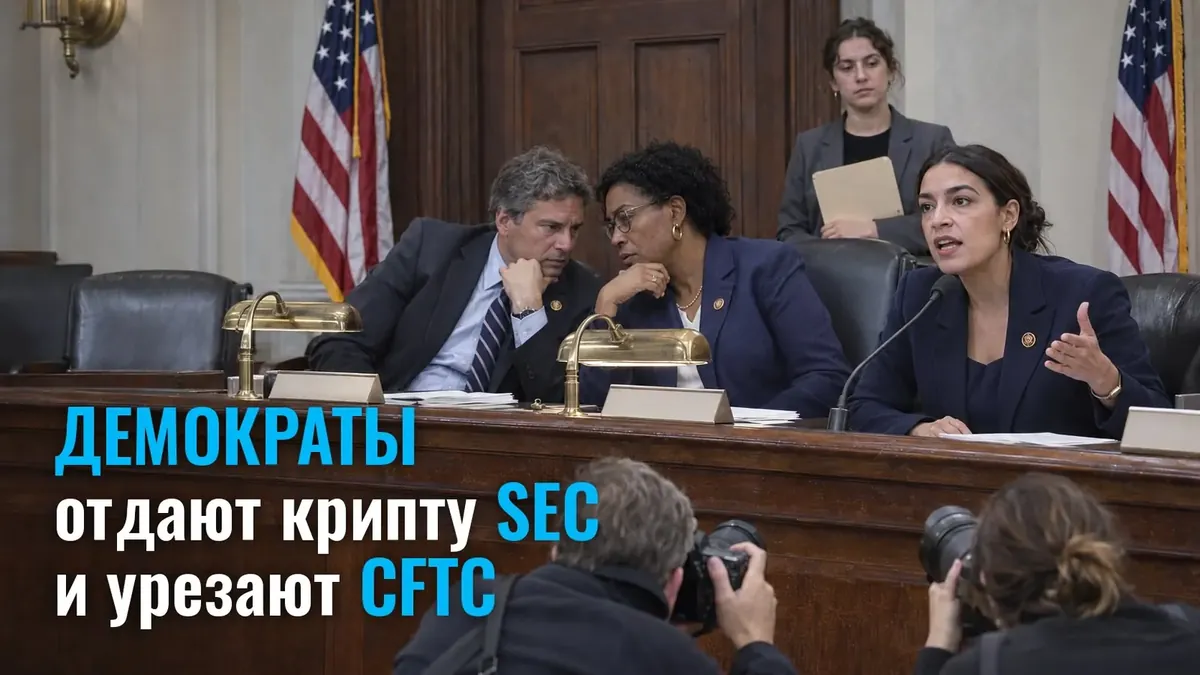
US House Democrats are preparing their own bill on crypto market rules. Journalist Eleanor Terrett reported on the discussion on November 4. The draft gives primary oversight of the industry to the SEC and curtails the CFTC's powers.
Who these regulators are. The SEC is the US securities commission. The CFTC is responsible for commodity and futures markets. The Republican version of the law made the CFTC the primary regulator; Democrats want to reverse that decision.
Why this matters to a trader. The regulator sets the rules for platforms: token listings, staking, access to futures and reserve requirements. The trading conditions on US exchanges are written at this level.
What's in the draft?
The basis is Maxine Waters' amendment "Crypto Investor and Consumer Bill of Rights." It describes the obligations of exchanges, brokers and custodians to the client.
- 24 hours - the deadline by which a platform must withdraw a client's money
- Separate accounts - client assets are protected from the platform's bankruptcy
- Direct consent - without it, coins cannot be lent out or staked
- Monthly reserve report - with confirmation by an independent auditor
- 48 hours - the deadline for reporting a hack
Staking is placing coins at interest.
Two more requirements. A platform must act in the client's interests. Front-running their orders with its own trades is prohibited.
What is the dispute about?
The Republican CLARITY Act passed the House in July 2025 by a vote of 294 to 134. It gave the CFTC primary oversight of the spot market for digital commodities and left the SEC only with securities.
- Senate. A procedural vote in September produced 49 to 50, and the law stalled.
- Waters amendment. The House Rules Committee blocked it from consideration - 8 to 4 in July 2025.
What does this mean for a trader?
The main point: the choice of regulator determines token listings, staking terms, access to futures and reserve requirements on US exchanges.
The timelines are long. Any such law must pass both chambers and be signed by the president. It is months before it takes effect. Votes on the topic are conveniently tracked alongside other events in the economic calendar.
What's next?
There is no text of the bill, and no date for its introduction has been given. This concerns the next Congress after the midterm elections on November 3.
- Source of information. Three people from the industry who spoke with Democratic staff.
- Another topic under discussion. Ethical restrictions on the crypto interests of Donald Trump and other federal officials.
- Republicans' reaction. They view these talks as setting political priorities and see no preparation for a bipartisan law in them.
Laws change, but the deposit stays the same
While Washington divides powers between regulators, crypto delivers moves that you wait weeks for in a calm market. Guessing the direction is half the task. The other half is the notional: 5% on BTC in a personal account of fifteen hundred dollars turns into seventy-five dollars. Prop trading works differently: the company issues a trading account after a paid test of loss limits, and profit is split according to a pre-defined share. It is calmer to work out the mechanics now, while the bill still has no text.