

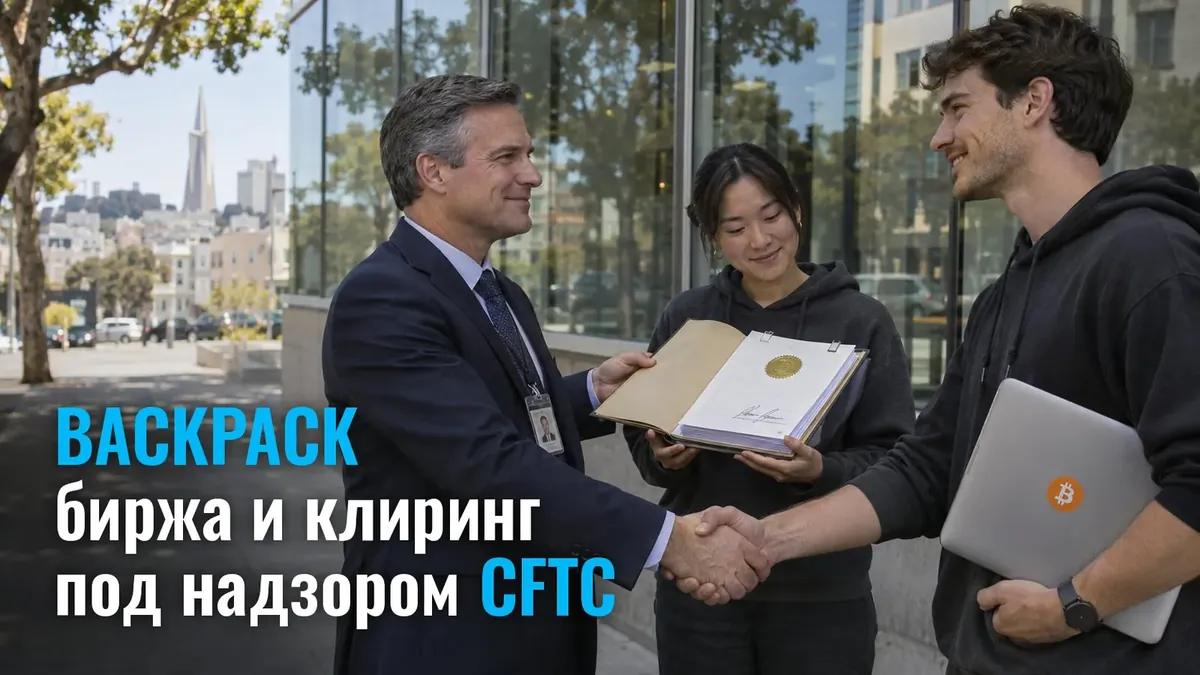
The CFTC registered two Backpack entities: a clearing organization and a regulated futures exchange. The orders were signed on November 13 and 16.
The CFTC is the U.S. federal regulator of derivatives. A clearing organization stands between the parties to a trade and is responsible for ensuring that settlement occurs. A regulated futures exchange is a venue where contracts are traded under the regulator's supervision.
For a trader, this means that the platform's crypto futures in the U.S. now operate within a legal framework: settlement and listing under CFTC rules.
Two orders in a row
The regulator issued two separate documents.
- November 13: the CFTC registered TLD Clearing as a clearing organization; the company operates under the Backpack Clearing brand.
- November 16: TLD Markets, a Delaware corporation with an office in San Francisco, became a futures exchange.
- Signature: the clearing order was signed by CFTC Deputy Secretary Robert Sidman.
What clearing is permitted
The document names two groups of contracts, and a separate clause specifies whose money the participants' funds are considered to be.
- Margined futures: a portion of the position's value is posted against it.
- Fully collateralized contracts: futures, options and swaps, CFTC Rule 39.2.
- Members' money: clearing members' funds are considered their property under U.S. bankruptcy law and are held separately from the clearing center's own money.
The exchange's obligations
TLD Markets has committed to maintaining an anonymous electronic order book.
An order book is a single queue of buys and sells that are matched by price and time.
- Clearing of listings: each contract is cleared by an organization registered with the CFTC.
- Board of directors: it will include independent directors.
- Supervision: trades are monitored in real time and the following day.
Perpetual futures are still only planned
Backpack is only planning round-the-clock perpetual futures with collateral in fiat and crypto, but the orders do not approve this plan and do not connect U.S. liquidity with the rest of the world.
A perpetual future is a contract with no expiration date.
- From March 27 to November 16, 2026: the regulator reviewed TLD Markets' application.
- The CFTC's right: registration may be limited, suspended or revoked.
Key point: the statuses concern settlement and listing; they do not open trading in perpetual contracts.
The challenge and payouts are broken down step by step in the academy, and you can find a challenge for futures in the calculator.
Trading perpetuals? The question is volume
You are most likely already trading perpetual futures. The only question is where and with what volume. Margin is calculated from the contract's notional value, so the ceiling on a position is set by the deposit you assembled yourself. Prop trading removes this ceiling: the challenge is paid for, the trading account is provided by the company, and profit is split according to a pre-stated share. It makes sense to study the scheme in advance.