

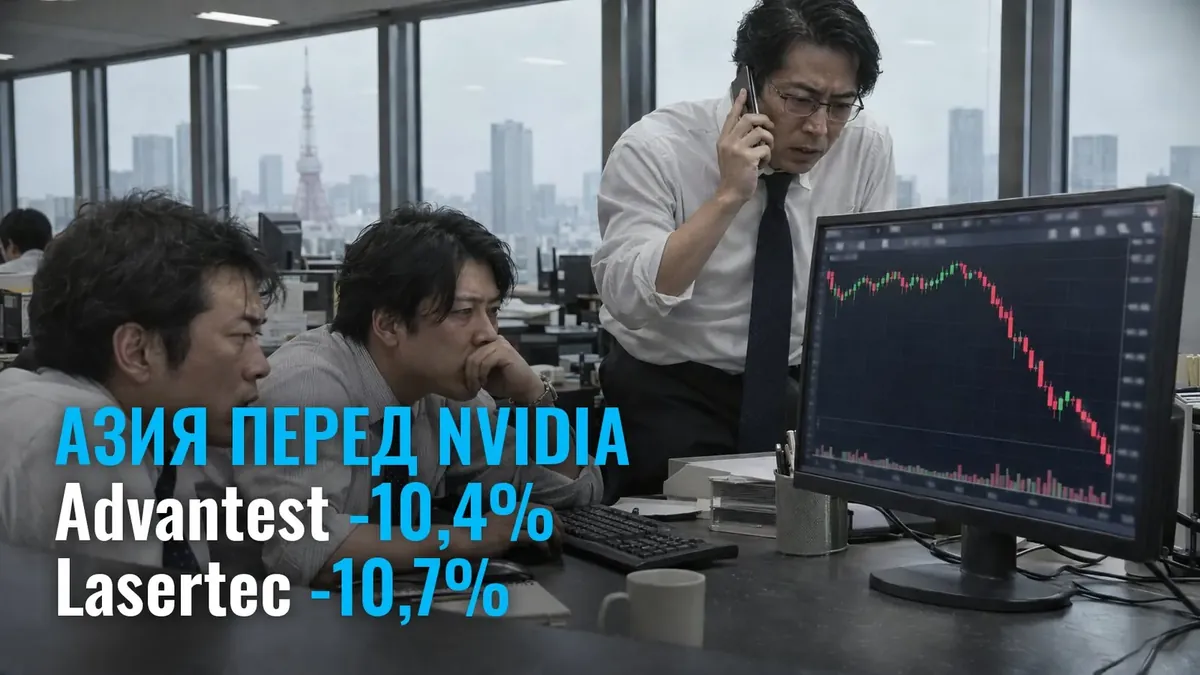
Asian markets sold off chip-related stocks on Monday morning. The Nikkei 225 fell as much as 2%, the Korean Kospi as much as 3%. Individual stocks dropped by double-digit percentages.
The Nikkei 225 is the main index of Japanese stocks, the Kospi is Korean. The index shows how stocks on the exchange are moving on average.
There is one reason - Nvidia's quarterly report on Tuesday. Orders from Asian factories are tied to purchases of chips for artificial intelligence, so their stocks move in advance.
Who fell the most
Japanese suppliers of chip manufacturing equipment fell the most.
- Advantest dropped 10.4%.
- Lasertec lost 10.7%.
- Tokyo Electron fell 5.7%.
- Samsung Electronics in Korea lost 5.8%, SK Hynix there too - 4.2%.
- TSMC in Taiwan fell 3.8%. It is the world's largest contract chipmaker, producing processors on order for Nvidia.
The Asia readings were taken around 07:00-07:15 Moscow time.
Why these particular stocks are falling
- Nvidia's report: on Tuesday the company publishes its third-quarter results.
- Change of leadership: this is the first report after founder Jensen Huang stepped down as CEO.
- Dependence on orders: Asian factories and memory makers work to supply purchases of chips for artificial intelligence.
Nvidia's report figures
In August, Nvidia itself guided the market to revenue of $108 billion plus or minus 2%. This amount excludes shipments of computing solutions for data centers in China.
- $109.3 billion is the Visible Alpha consensus according to S&P Global Market Intelligence, and this is above the company's own guidance.
- $101.8 billion of this amount comes from the server segment.
- $162.85 was the price of Nvidia shares at Friday's close, having lost 2.01% during the day.
Revenue expectations have risen since last quarter. The market is pricing in demand for new Blackwell chips.
What's next for the trader
- Tuesday, after the US session closes: Nvidia publishes its report.
- Immediately after the report: the company holds a call with investors.
Key point: until Tuesday, supplier stocks trade on expectations, and the actual figures will come only after the US market closes.
Dates of upcoming events are in the economic calendar. It is convenient to calculate trading in indices and stocks within company limits in the challenge calculator.
Did you watch the overnight session in Asia?
I watched this overnight session and calculated how much it would have yielded with a normal lot. The move was easy to read, only the account size got in the way. Ten percent on a single stock gives an amount there that you wouldn't notice in a report. Prop trading removes this arithmetic: a paid evaluation within company limits, then trading with its nominal capital and an agreed share of the profit for you. It's better to understand the mechanics before the next reporting Tuesday.