

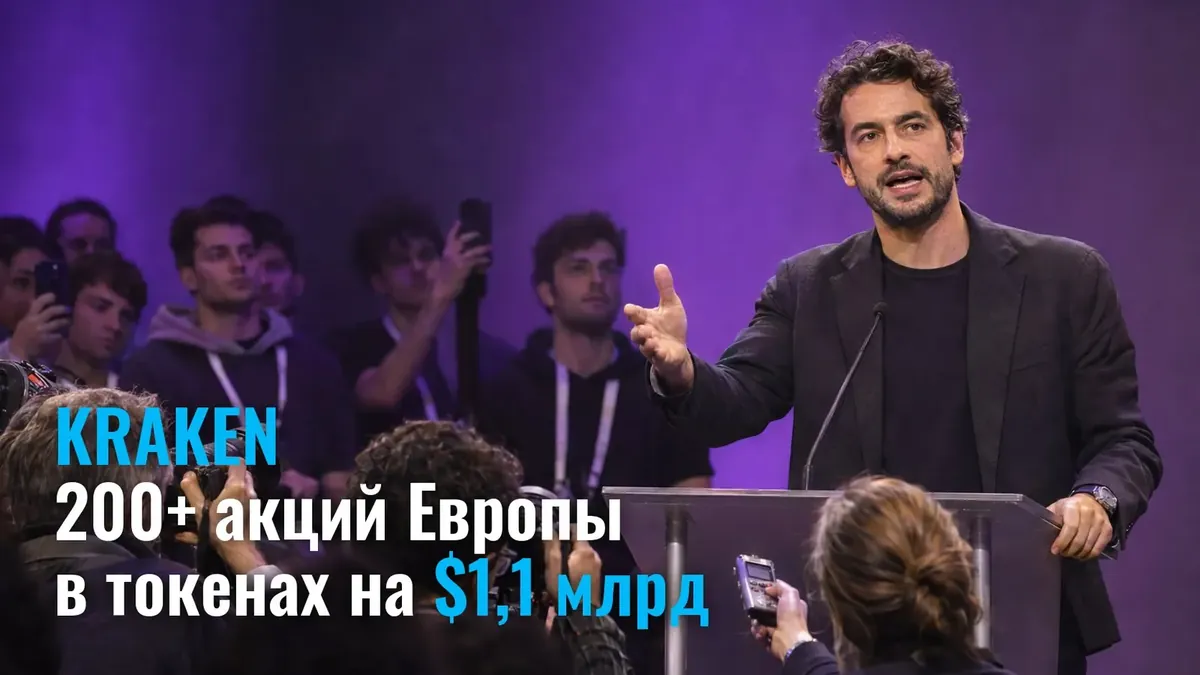
Payward, the parent company of the Kraken exchange, has added more than 200 British and European stocks to the xStocks service. The list includes all 40 companies of the German DAX index, including SAP, Siemens and Allianz.
What xStocks is. This is a tokenized stock service. A tokenized stock is a record on a blockchain that mirrors the price of a real security. You can buy it just like cryptocurrency.
Why this matters. The service now has more than 1,500 tokenized securities, with assets under management exceeding $1.1 billion. For a trader, this is another way to hold a position in European stocks.
How much the service has grown
The service reports the following current figures:
- $1.1 billion - assets under management
- 550 thousand - token holders
- $45 billion - cumulative turnover since launch in June 2025
Comparison with February. Back then there were $225 million in assets, 80 thousand holders and $25 billion in turnover. Assets grew 4.9 times, the number of holders - 6.9 times.
Positions have become smaller. The average position shrank by 29%, to roughly $2,000. The trading pace since February is $2.3 billion per month versus $4.7 billion before that, i.e. twice as slow with four times the volume of assets.
What stands behind the token
Each token is backed by a real stock. It is bought at issuance and held for as long as the token trades.
- Custody. The security is held by a regulated custodian. A custodian is a custodian bank that holds clients' securities.
- Rights. The token does not grant rights to a share in the company itself.
- Dividends. They do not arrive in cash to your account; they are reinvested into additional tokens.
- Voting. Since August, holders can pass on their position on shareholder votes via Broadridge.
Where and to whom the securities are available
New securities trade from day one on Kraken and the platforms of the xStocks alliance.
- Issuance networks - Solana, Ethereum, TON, Ink and X Layer
- Geography - 110-plus countries
- No access - Britons and Americans
The reason for the ban lies in the token issuance scheme itself, not in which exchange the companies themselves trade on.
Key point: the token mirrors the stock price but does not make you its owner. Each program has its own list of available instruments, and it can be seen in the prop firm catalog.
What's next
Brokerage and custody infrastructure was provided by partner GTN: six regulated entities and more than 90 markets. Thanks to this, hundreds of securities were rolled out within a few weeks.
The next step is the remaining international markets. This was stated by Payward's Chief Commercial Officer Mark Greenberg. Hong Kong is named in the plans.
- What a trader should check - whether the stocks and indices you need are in the program you want to take
- How to help yourself - pick a challenge for your market in advance, before paying
Wondering how to trade SAP or Siemens?
A token on a blockchain and a position in a prop firm account are different things, and it all starts with the list of instruments. Some programs have European stocks, others offer only indices like DAX 40. In others, entering a stock is prohibited on the day of its earnings report. All of this is set out in the rules and is visible even before you pay for the evaluation. While you are comparing without an open position, a mistake costs you only time.