

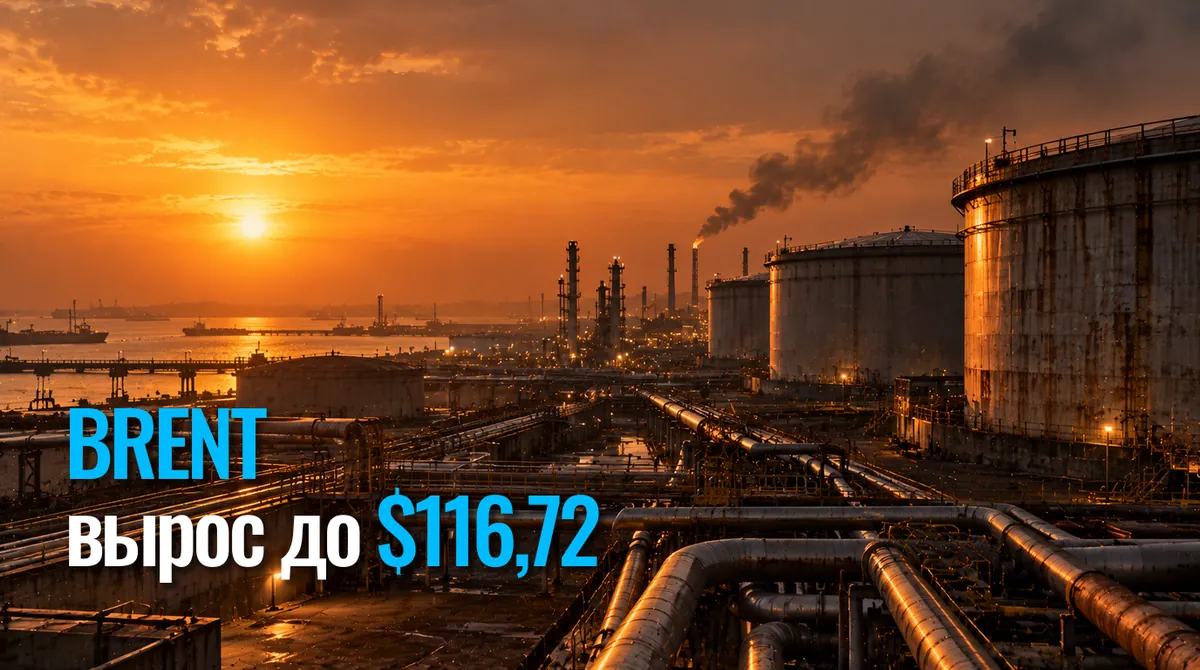
During Friday's session, Brent rose above $117, with late quotes standing at $117.23-$117.30. The American WTI grade closed at $103.27, adding $3.80, or 3.8%.
The reason for the rise is a series of Houthi attacks (the Yemeni movement backed by Iran) on targets in Saudi Arabia. "The rise is driven by fear of supply disruptions after attacks on infrastructure," said Adam Turnquist, chief cross-asset strategist at LPL Financial. Houthi spokesman Yahya Saree listed Aramco facilities in Yanbu, the refinery in Rabigh, pumping stations and the East-West pipeline, as well as the airports of Riyadh, Dammam, and Najran.
The main unconfirmed fact is whether there was a strike on Yanbu. This is the East-West pipeline's outlet to the Red Sea: about 1,200 km from Abqaiq, with throughput, according to the head of Aramco, close to 7 million barrels per day. Since July, when Iran closed the Strait of Hormuz, this has been the kingdom's main export route. In September, after a drone attack, the line was halted: on September 15, Aramco suspended loading in Yanbu and canceled deliveries to European buyers.
Riyadh has not confirmed the damage. The coalition reported that it shot down two ballistic missiles toward Yanbu and Taif, and on Sunday - an interception over Riyadh and ten more missiles toward the south of the kingdom. Futures trading opens at 01:00 Moscow time on Monday, with Brent reference levels at $108 on the downside and $120 on the upside. The Fed meeting is also taking place this same week.
Did you see the headlines about Yanbu on Friday?
The move was easy to read, but capturing it is a question of nominal size. On a deposit of two to three thousand dollars, a $3.5 move per barrel brings in tens of dollars, not a week's result. Hence the point of prop trading: the capital for the trade is allocated by a third-party company, and your task is to stay within its risk limits and take the agreed share of the profit. Oil travels from $108 to $120 quickly, so it makes sense to understand the mechanics in advance.